Galactic Racer Drafting: Follow for Position, Leave for Visibility
Plan a draft around visibility and the next exit. Practice a repeatable follow-and-leave sequence without invented boost multipliers or distance thresholds.
By Star Wars Galactic Racer Guide editorial team Last updated
Use a draft only while you can still read the route and leave it deliberately. Decide where to move before the next braking or turning reference disappears behind the racer ahead. The aim is to arrive in a position you can use, rather than remain close for its own sake. This guide does not publish a measured slipstream multiplier or an exact distance threshold.
Establish what you can actually observe
First distinguish the sensation of following another craft from a documented mechanic in the current event. Read the game’s available prompts and watch the feedback it provides. Do not infer an exact speed bonus from one overtake, because the vehicles, inputs, route and traffic may differ.
Keep the practical question simple: can you follow without losing the next decision point? If the answer is no, increase the gap or move to a line with better visibility. Any potential advantage becomes difficult to use if it delivers you to a bend you cannot read.
The official game descriptions establish high-speed racing and contact between rivals. They do not provide a universal safe following distance. Use the room you need for the current craft and section, and adjust when the route or traffic changes.
Pick a familiar section for practice
Choose an event and vehicle you already understand. Learn the road alone or with enough space that another craft is not hiding the entry. Identify a visual reference before the turn and the exit you intend to use. Then practice following without changing the rest of the setup.
Do not begin on the section where you already make repeated errors. A draft adds another variable: a moving obstruction and a rival whose inputs you cannot control. Establish the line first with the track-practice method, then return to the traffic problem.
Write down one question for the attempt. For example: can you leave the wake before the approach marker while staying on a usable line? That question produces a clear result. Trying to overtake everyone and improve the whole lap at once produces a much less useful comparison.
Choose the departure before entering the wake
The important decision can happen before you tuck in. Identify where the road opens, where it narrows and which side offers a viable exit. If the route gives you no safe place to move alongside, you may be better off preserving space than entering a tightly constrained follow.
Watch the wider scene. A vehicle ahead can move because of another racer you cannot see directly. Leave room to respond to that change. Do not assume that an opponent will continue on the same line merely because they held it for the previous straight.
Choose a departure reference that remains visible. A landmark on the far side of the road may disappear behind a large craft at exactly the point you need it. If you cannot find a stable reference, leave earlier until you know the section better. An early, controlled departure is easier to learn from than an emergency swerve.
Visibility problems are a reason to change the plan
Spray, particles, lighting or the vehicle ahead can obscure the route. Whatever the cause in your event, judge the information you still have. If you are guessing where the next bend begins, you have stayed too committed for the visibility available.
Increase the gap or take a clearer line before adding speed. Do not treat another racer’s silhouette as a substitute for your own route reference. They can make a mistake, choose a line unsuitable for your vehicle or react to something you cannot see.
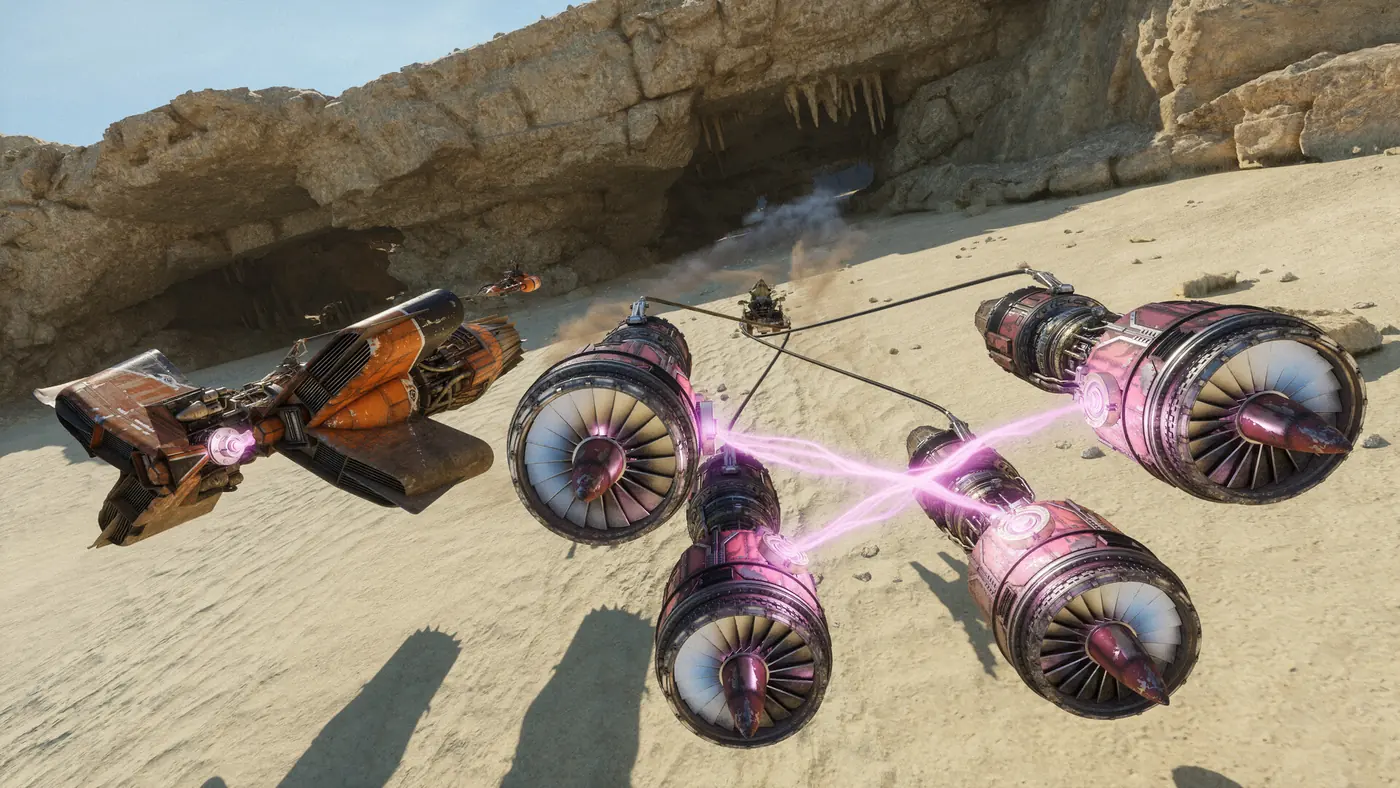
This is particularly important when changing vehicle classes. Podracers are described as larger and faster than the speeders, and they race separately. Use the podracer guide to establish clearance and approach margins rather than copying a speeder-following habit without adjustment.
Turn a follow into a usable pass
Before moving alongside, check where you will be after the move. A pass that leaves you outside the usable road at the next turn is not complete simply because your nose briefly reaches the front. Look for enough room to settle the craft and make the next input deliberately.
If the rival changes line and removes the opening, abandon the pass while you still have room. Avoid stacking a contact attempt on top of a failed departure unless the resulting line is clear. The shunt guide explains why a deliberate contact plan needs its own exit.
After moving out, resist an immediate second correction made only because the first felt slow. Finish the maneuver and observe the result. Repeated small changes can be necessary in traffic, but they should respond to something visible rather than uncertainty about what you intended.
Common failed attempts
When you miss the turn while following, check whether you lost the marker or entered too fast. Those are different corrections. A visibility problem calls for an earlier move or a different reference. An approach-speed problem calls for a change before the turn, even if the road remains visible.
When you collide while moving out, check whether the intended lane was actually clear and whether the rival was already changing direction. When you leave cleanly but gain nothing, record the result without inventing a missing bonus. The event conditions may not support the expectation you brought into it.
When the image hitches during several unrelated actions, use PC diagnosis before rewriting the driving technique. A technical interruption can invalidate an otherwise controlled comparison.
A useful practice result
Finish with a repeatable sequence: follow only while the road remains readable, leave at a chosen reference, and complete the next section with control. Compare attempts under the same conditions and note whether traffic forced a different decision.
There is no need to publish a fabricated optimal distance to make that routine useful. The result you want is an approach you can explain, a departure you can deliberately repeat and enough margin to change your mind when the opening closes.